


In recent decades, infusors have been used for continuous drug administration. The development of these devices is a major breakthrough in this field, as maintaining stable plasma concentrations allows better control of the disease and its symptoms, while improving patient quality of life.
Elastomeric infusion systems (or infusors) are single-use devices that do not require batteries. They mark an important step forward in the administration of various types of drugs and are adapted to both inpatient and outpatient settings.

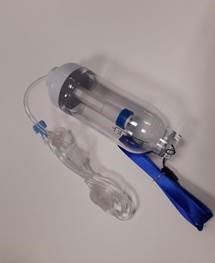
What is an infusor used for?
The drugs that can be administered through this system include analgesics and chemotherapy required by cancer patients, drugs to treat the symptoms presented by terminal patients in palliative care, drugs prescribed to treat pain (both chronic and acute post-operative or traumatic pain) and treatment of infections.
Routes of administration
- Intravenous (IV)
- Intra-arterial
- Subcutaneous
- Epidural
Comparison with an electronic (cassette) pump
These electronic devices have the same indications as the infusor; they are used by patients who need to undergo an infusion but who are not necessarily hospitalised.
Points to note:
– The use of the electronic pump involves a steeper learning curve due to the complexity of the menu and its programming
– A power supply is required for charging
– The pump is more precise as it does not depend on the factors that affect the infusion of an infusor.


Advantages of infusors
Outpatient design: Does not require cables or batteries.
Discreet and lightweight design
Single-use device
Latex free
Quiet operation
No programming required
Easy to use
Portable device that adapts to each patient’s lifestyle


2. Hard Casing (can be graduated or not)
3. Bottle cap
4. Balloon reservoir
5. Filling port (one way valve)
6. Perfusion line
7. Robert Clamp
8. Filter
9. Flow regulator
10. Luer connector
11. Cap
Differences between an elastomeric infusor flow restrictor and a flow selector
The terms flow restrictor and flow selector can be confusing.
But what do they mean?
There are two types of elastomeric infusor on the market:
- The basic mechanism of operation of a flow restrictor infusor is a distended balloon (elastomeric reservoir) inside it that exerts a constant pressure that pushes the liquid drug into the catheter. The flow rate (preset for each type of infusor) is controlled by a restrictor: a capillary with a specific calibre and length (usually made of glass) located inside the infusion tube. This restrictor delivers a fixed flow rate for each type of infusor (2 ml/h, 5 ml/h, etc.). Some manufacturers also call it a flow regulator. The speed of administration is predetermined for accurate and reliable dosing, which means that no programming is required.
- On the other hand, there are variable flow infusors: the flow rate is controlled by a flow selector, which is a device that has several positions that deliver a different flow rate for each position (1-2-3 ml/h, etc.). This allows professionals to regulate the flow according to the patient’s needs with the same infusor. Below is an example of infusor with variable flow rates:


Soft Elastomeric Infusors
Infusor with a soft outer casing are also available. These infusors offer a better comfort for the patient because of their soft outer casing. However they are also more prone to compression and thus flow rate can vary if outside pressure is exerted on the elastomeric. Usually Soft infusor are not recommended for children. Below is an example of Soft infusor.

